After watching the first episode of Knight of the Seven Kingdoms, I decided to read the novel first.
The first half of the episode follows it almost word to word, minus the defecation part.
The differences start with the sign-up for the tourney, in which the series add a lot of character, and the character of Baratheon. In the novel he’s very much a side character, mentioned twice.
The novel does focus a lot on Targaryens, and there are a lot of them too. Two prices, one with three sons, the other one with one. The entire story of heirs not fit for purpose is very much England history, as well as Baelor, ideal prince never to be king, is basically Black Prince, only Black Prince died from malaria.
The single bout Dunc has is quite realistic: instead of a story of an underdog beating more and more experienced opponents, we have a single fight, were Dunc can barely see or hear anything, and almost dies.
Category: *.MP3
О музыке
Finished Dune Messiah. I wish I could say it was the worst book I’ve read in a long time, but then I’ve read “I am Pilgrim” not that long ago.
It’s still terrible, though. The worst is Alia, as Herbert says she’s that prodigy, but she’s completely unable to connect the dots. Like when she’s sent to investigate a corpse in the desert, unable to identify it, then when a fremen girl suddenly comes with a proposal to resurrect Chani she doesn’t think “that’s a tiny bit suspicious”, but instead brings the shapeshifter directly to Paul.
And it’s doubly ironic that after that “meticulous” plan to give resurrected Idaho to Paul so he would be convinced how good the technology is and tempted to give away his Empire in order to resurrect his wife (really? An Empire for a wife?) the shapeshifter doesn’t find anything more cunning than pointing a knife at Paul’s newborn.
But Paul has another never hinted at deus ex machina, with his ability to see through his newborn’s eyes. So because everyone things he’s blind, he manages to fool the shapeshifter and best him. Although actually, only Paul knew he couldn’t see, everyone else should have though he could. So Herbert bested himself.
Oh, and remember the metallic eyes Idaho has? They play no role whatsoever. None. You would think if he was recreated to show Paul how good the technology is they would pay more attention to making him less uncanny.
And then Alia declares her love to Idaho, who’s a cyborg 20 years older than her, and she had a couple of interractions with, one including him hinting that he could force himself on her. Yeah…
Suffice to say, if I ever try “Children of Dune”, it won’t be right now.
The only character I like in this book is Bijaz the dwarf:
“His mouth rattles, but there’s no harm in him,” Otheym said, affection in his voice, the one good eye staring at Bijaz.
“Even a rattle can signal departure,” Bijaz said. “And so can tears. Let’s begone while there’s time to begin.”
And this is why I hate the rest of the characters:
“You’re not a despot!” she protested, tying her scarf. “Your laws are just.”
“Ahh, laws,” he said. He crossed to the window, pulled back the draperies as though he could look out. “What’s law? Control? Law filters chaos and what drips through? Serenity? Law—our highest ideal and our basest nature.
Don’t look too closely at the law. Do, and you’ll find the rationalized interpretations, the legal casuistry, the precedents of convenience. You’ll find the serenity, which is just another word for death.”
The strange twist is that while Paul learns about conspirators, a “stone burner” goes off. It’s a strange bomb, nuclear, powerful enough to burn to the planet’s core, but only blows a couple of houses. Still it burns Paul’s eyes. But wait, he isn’t blind, he can see in his mind! But maybe he’ll use it to fool his enemies? No, he immediatelly announces to everyone that he can see without eyes. So why add this in the first place?
First Dune was Lawrence of Arabia fanfic with Hamlet sprinkled on top (took Brandon Sanderson to explain that familiar taste I couldn’t put my finger on).
With the positive influence gone, it just gets weird.
Aliya, Paul’s sister, is literally horny, so she decides to spare with a dummy naked. Of course she reaches level 11, while even the fencing masters are level 7. Then Paul walks in, and scolds her telling that he once reached level 10, but was scolded by his tutor for being so amazing in everything.
Later in the book, the story becomes outright petty. There’s a shapeshifter plotting against Paul, and he takes a shape of a Bedouin woman telling Paul that her father wants to share a conspiracy plot with Paul, but he must come personally accompanied by Chani, his concubine. A reminder, Paul is the Emperor of Mankind, 650 billion died in 12 years opposing him, but sure. And the “Bedouin woman” even has an argument when he refuses to bring Chani.
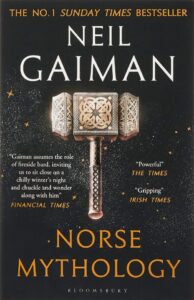
Finished listening to retelling of Norse Mythology by Neil Gaiman, voiced by the author. The main hero of most of those stories is Loki. Usually, he does something stupid, because he’s drunk and thinks that would be funny, then spends the second half fixing his errors.
Interesting that Gaiman voices the idea that Aesir and Vanir were gods of two tribes. The tribe of Aesir conquered the farmer-Vanir worshippers, and incorporated them in their pantheon as hostage gods. Same idea was voiced by Robert Howard, author of Conan the Barbarian, back in 1930.
There’s also no real distinction between gods and giants. Gods can turn into animals. So can giants. Gods can mary female giants, and giants in true Greek fashion can steal godesses. Moreover, some if not all of the gods were born from giants, and as with Tyr even visit their parents sometimes.
Categories
Britney Spears – Break The Ice
I’ve never heard that song, nor seen the clip until now.
But all I’ve got to say: Ghost in the Shell changed the world forever.
Also, the character looks like Sarah Bryant from Virtua Fighter. At first I thought it’s some old OVA.
Finished listening to Shadow of the Gods. It’s an easy read overall, with some well set plot twists: death of the elder of the fishermen brothers, betrayal of the Battlegrim.
One topic the author has troubles with, though, is the scale of the monsters.
Is the dragon as big as two meadhalls or small enough to bite a human’s head off? You can’t have both.
I usually have troubles with character names, and here it’s even more pronounced than usual. Breka is the timid son of Orca, and Dreka is the guy that killed Orca’s husband and kidnapped Breka?
Bjorn is Elvar’s lover and betrayer, and Bjarn is the kid that Elvar set to rescue, and there’s also Bjarn’s father with a similar name 😫
Started listening to the 3rd book of the Wheel of Time. It feels like Jordan was paid for every word.
Here’s a typical “dialog”:
— Can they?
— This is something known only to a few, child, even in the Tower. You should not learn it now, if ever, but I will tell you. There is—a weakness in being able to channel. That we learn to open ourselves to the True Source means that we can be—opened to other things. Calm yourself, child. It is not so easily done.
It is a thing not done, so far as I know—Light send it has not been done!—since the Trolloc Wars. It took thirteen Dreadlords—Darkfriends who could channel—weaving the flows through thirteen Myrddraal. You see? Not easily done. There are no Dreadlords today. This is a secret of the Tower, child. If others knew, we could never convince them they were safe. Only one who can channel can be turned in this way. The weakness of our strength. Everyone else is as safe as a fortress; only their own deeds and
will can turn them to the Shadow.
One character, usually a younger one, asks a simple question, then another character spills that bullshit load of lore on them without blinking. That is not how people talk.
The fact that a book is promoted doesn’t mean it’s any good. This one isn’t.
The hero is a Mary Sue. The youngest in the Service, bla-bla. Shoots his boss because he’s working for the Russians. Gets his job. Yeah, right. Also, he’s the adopted son of a millionaire, so it’s not an issue for him to retire at 30 and do whatever he likes. Like writing the best book about criminal investigation ever. Because why not.
Storytelling is amateurish. The author wanted to tell the story from the first person, but then decided he needed to tell another story from 10 years ago, which is supposed to be based on accounts of interrogations, but contains details nobody would mention, like what was going on in the head of a terrorist, or his soon-to-be dead victims. Amateurish.
“Young Germans don’t blame their parents for starting the war. They blame them for losing it.”
Out of all John le Carre novels I’ve listened to until now, this is probably the best novel in terms of narrative yet. And it’s not really a spy novel, again! It’s a classical noir novel, with a “detective” in a trench coat, corrupt cops, unfaithful wives, and… Nazis.
The best part of the book, that made me laugh out loud, was the dinner that the head of Chancery, Bradfield, hosts. How the German and Dutch swear their “allegiance” to Britain, “my son studies there, my daughter studies there,” is so similar to how 50 years later, every Russian oligarch still sends their kids to study in Great Britain.
On a more serious and more nuanced tone, the book discusses what is the age of the Nazis’ crimes. Should they be forgiven in ’45? ’55? ’65? Never? Why is one arbitrary date better than the other?
And of course, common to le Carre is the theme of abandonment by your country, in this case, of a hunter for Nazis and a Jew asked to “forgive and forget.”
Finished listening to “Player of Games”.
This is basically a spy novel wrapped in Banks’ sci-fi utopia. A professor in game theory is bored with everything, and recruited by an intelligence agency to participate in a complex game played in a distant empire.
The empire is a parody on modern Britain, with fashion that haven’t changed hundreds of years (ouch), and all government positions decided by a result of a particularly elaborate Game. Hence universities that teach The Game have huge influence on politics of the Empire (ouch, ouch).
For ’88, the book is quite progressive. Banks plays with the idea that in the utopian future, people would be able to change their sex back and forth, for example. He also dedicates a lot of attention to the fact that AIs in this society considered to have the same rights as humans.
Overall, I enjoyed it far more than “Consider Phlebas”, his first book. It describes the obsession of something like a chess player quite well.
Recently I discovered HARDKISS. Better late than never, I guess.
Finished listening to Spy Who Came in from the Cold. And I can’t say that I enjoyed it much. Actually, I can’t say I enjoyed this book at all. It’s narrated very well, but that’s part of the problem. The hero is always grumpy, so you listen to a grumpy British actor for some 6 hours, or however long that book takes.
By the last third, the book turns into a procedural. Not sure how accurate proceeding in DDR are, and don’t care much about them. And the finale is just lazy. But that’s nothing new for John Le Carre.
Half of the book the hero tries to convince East German Intelligence Service that their head is a British mole. He fails, they requite him. Then it turns out he is a mole after all.
The girl gets shot trying to climb over the Berlin Wall, and the spy can’t bear that and apparently gets shot too. The end 🤷♂️
I think that someone who managed to make this:
And this:
Knows what they’re doing. I’m no expert, but there are some solid Amy Winehouse and Lady Gaga references there.
But this surprised me:
Everyone regards this as something personal, and I think it’s not, but still that’s a much more heavy theme that club music.
Finished listening to Consider Phlebas. On one hand, I was surprised this book was written in ’87. It seems to be 10 years ahead of its time at least.
But the ending left me feeling unsatisfied, in an almost Warhammer 40K manner. You see, in Warhammer 40K, different factions usually chase an ancient artifact. In case of “Consider Phlebas”, it’s an artifact alright, although not ancient, but brand new: unique kind of AI, that managed to teleport itself into a planet, something no other AI managed to pull previously.
There’s a lengthy sequence of firefight for that artifact between humans and a couple of 3 meter tall warlike “Idiran”. Some people get killed. The protagonist decides to keep one of the Idirans captive. It escapes, and kills or mortally injures everybody else, besides a single crew member, that manages to return the AI to her people.
But then, the AI doesn’t seem to play any role in the ensuing war. Just like in W40K, where every artifact gets destroyed “because Chaos”, or, in other words, because no singular even can have any effect on the overarching story.
This music video is so bad it’s actually good:
“Zero” from Ace Combat Zero is one of my most favorite video game tracks of all time.
And this live performance of it is fantastic. Very interesting to see how the performer actually looks:
Последний альбом Nightwish терпимый. Лучше, чем два предыдущих, поскольку новая солистка хоть петь умеет. Но не лучше тех, где еще была Тарья. Хотя нет, может уровня Once, но не более того.
Зато неожиданно порадовали бразильцы из Semblant. Но с другой стороны, чем бразильцы хуже каких-нибудь чехов из Calathea?
Categories
Upon A Burning Body
Открыл для себя на днях группу Upon A Burning Body. Не Five Finger Death Punch, конечно, но тоже очень неплохо. Похоже названия групп меньше чем из трех слов в этом жанре не котируются. Для ознакомления советую Scars.
Categories
О группе “Кино”
Понимаю, что когда тексты группы были актуальны и злободневны, лет двадцать назад, слушать их было можно и модно. Но слушать это сейчас – нонсенс. Поет Цой слабо, играют музыканты кое-как, и ко всему прочему записано это на теплую ламповую “совковую” технику.