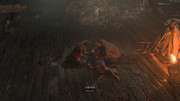
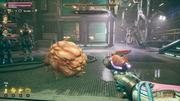
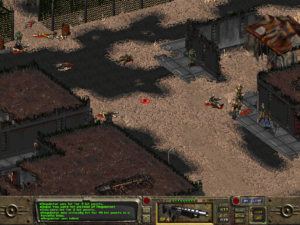
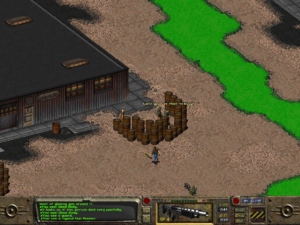
The game made me rage-quit a couple of times. But that is something you should never do. When you quit, enemies respawn. And your valuable ammo does not.
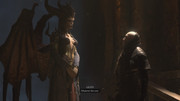
The fight with the Archivist boss instead of being fun felt mostly annoying. The boss can pass through walls, has a ranged attack that kills you in two hits. And another attack which slowly drains your health, apparently? I couldn’t figure out how it works, and the game doesn’t explain it properly. And it can kill you as soon as you respawn. Sounds like fun?
Not as “fun” as backtracking without a map and with tons of respawned enemies. Funny enough, judging by the few game guides, there was a map at some point, until it was removed.
Inadvertently I finished the first episode. I expected that I’d be able to finish some quests, as meaningless as they are, but I was thrown right into the second one.
I rarely drop games, but I think for Graven, I’ll make an exception. Which is a shame, I did enjoy the art style. But the lack of saves, a map, and a combination of too many enemies and not enough ammo, coupled with some bugs ruined it for me.
Author: TheAleosha
Eureka Mignon Libra coffee grinder
I wanted a grind-by-weight coffee grinder since I bought my first coffee grinder, Compak K3 some 7 years ago. At the time, there was only Baratza Sette 270Wi. Strangely, seven years later, there aren’t many choices either: either same 270Wi or Eureka Mignon Libra. There are mixed opinions regarding Baratza’s connical burrs design and it’s ability to grind for espresso. So, I decided to give Eureka a chance.
First few impressions:
Tiny. With the hopper, it is as tall as K3 without one, and much shorter. The feel if very compact.
Sharp edges. Compak is all round. The machine is round cone, the hopper is a round “hat”. Eureka is all angles, so sharp I almost cut myself getting it out of the box.
Smooth and clean. Eureka is known for making very quiet coffee grinders. While not very important for me, it is noticeably quieter. What was far more important for me, and one of the reasons I finally decided to get a new grinder, is the clumps and distribution. In the meantime, the coffee is clumpless, and comes out as in the videos, in an even stream. That also means that despite me not getting my funnel yet, it doesn’t leave as much mess as Compak does.
Now, I still haven’t dialed the grind, simply because I didn’t want to waste coffee. So maybe it will get clumps once I grind finer. We’ll see soon enough.
I expected Hexen 2 or maybe Heretic 2, but it feels more like Strife, with a proper town to explore, or even Arx Fatalis, as you expected to throw boxes around and burn wooden planks with fire spells.
It only takes a few hits for you to fall. Unreal was also quite unforgiving, but at least there was a save/load option. Here, I died a couple of times because I didn’t understand that there’s a lot of stuff that can blow up. Not just red barrels, but also red crates (no, they don’t contain ammo) and what I considered some altars, and turned out to be piles of tar. When you die, you lose some money.
Flying enemies are a bane in most FPS games. But here, they are tiny, hard to hit, almost black, and have an AoE attack that kills you in a couple of hits.
Succession S01
Completed first season of Succession.
It became my “flight series”, as I could watch it during takeoff and landing from my phone, as there isn’t much in terms of visuals.
Interesting how a story can be hyper-realistic and absurd at the same time. Kind of like Breaking Bad, I guess. But not as bad.
There are not a single character with redeeming qualities in those series. And no clear morals.
Does it make sense to continue buying cable stations, or should the company pivot? Is it immoral to sell family business, if the business is run by a demented tyrant, Logan? Would his weak son, Kendal, be a better alternative? Maybe by the end of the series there will be some conclusive answers. But that’s not a course in company management, after all.
I didn’t expect to enjoy it so much. Christian Bale and the guy from Blade Runner are great, but there is also the guy from Midnight Mass, and hilariously Kendal from Succession . And the evil guy from Umbrella Academy. Damn, I forgot the Umbrella Academy.
Breaking the 4th wall, led by Ryan Gosling, is something that movie does hilariously well.
The general tone reminded me of Dopesick, though. Everyone was “just doing their job”, “playing a system just a little”, and it all ended up in a huge disaster. But nobody paid the price for it. Except us, of course.
Unto The End
Completed Unto The End.
I think that there’s a fine line between being vague and obscure. At some points you’re asked to make an offering or a trade, and it’s not clear what exactly is expected. I guess I guessed luckily and assembled a Wanderer’s Totem, that let me past the “Ancient One”. But I have no idea what would have happened otherwise.
One annoying bit is that the game has frequent checkpoints, but it doesn’t allow you to revert to the last one. The only option is to start the game from the very beginning. And sometimes you do get in an unfavorable situation, like not being able to see your enemies behind obstacles or losing your last torch, stumbling in darkness, unable to progress or die.
Some fights felt like too much guesswork for me too. In those case, you’d be lucky to have a spare spear. And I just ran past some of the enemies. Often they’ll leave you alone if you do.
Only on the last boss I discovered that there’s a setting to slow down fights. To my defence, I didn’t know it’s the last boss either. It’s not graceful, as it slows everything, including character movement. Luckily, the boss is quite fair and takes only a few hits to go down.
Unto the End
This is an interesting mix. Minimalistic interface, slow moving character and traps resemble a limboid. But there are fighting mechanics, with telegraphing enemies, resembling soulslike.
But then there’s no visible stamina, and no penalty for death, no bloodstains. There are campfires, though. There’s also roll vs block mechanic, but here the game adds something I haven’t seen in this genre, although it appears in fightings: high and low blocks. Every enemy telegraphs a chain of high and low attacks, and if you block all of them, you can riposte.

One nice detail is that you can upgrade your armor by collecting different junk, and it changes your appearance slightly.
Loch Lomond Spearhead Whiskey,
Completed Chorus.
It’s quite a spectacular game, in the most direct sense. You’d rarely see more magnificent space battles as the backdrop of your exploits.
The final battle with “the Dragon” can get overwhelming a bit: swarms of nanomachines, space rays, and meteorites (what?) flying at you from all directions, while you need to chase the ever-rotating serpent. But thanks to checkpoints, it never gets to the point of being truly annoying.

The story is exactly what you’d expect: a Mass Effect, gather everyone together the beat the Cosmic Evil kind of story. But it’s well executed, in a classic sense.
Funny that although at the beginning, the game tried to force you to switch between weapons, by the end you can do fine with just the minigun.
And the final episode where you just spear through frigates is again, just spectacular.
Looking Glass War, John le Carre
This is almost a satire. Instead of the almost omnipotent Circus from the previous books, the story focuses on another bureau, which is a complete opposite. Where agents carry their real documents with them on a mission, tell state secrets to their families, forget important backstory facts and mostly worry if they’ll be reimbursed for the taxi they took to the office.
Also, this may be a critique to British methods do act as if it’s still WWII, including using outdated and complicated WWII communication devices, because “people are used to them”.
As usual with Le Carre, the preparation to the operation is eighty percent of the book, while the operation itself, if it can be called it, is maybe ten percent.
The book is even more vague what is fact and what is fiction than some other novels, which is interesting. It is never clearly explained who killed Taylor, was the film real or just a setup. And probably that was never the point. As there are also no significant outcomes either, despite the obvious setup by the Circus to the Department, the later seem to continue functioning.
HiFiMan Sundara
The irony of life. I wanted open-backed headphones for years now, since I tried Shure 1840 on. But I wasn’t buying them, because my PC was in the main room. But for the last 2 years, it’s in my bedroom. But I still didn’t buy them. Until now.
Basically everyone recommends Sundara. So I finally got them.
The pack is not just minimalistic, it’s dingy. Brown cardboard with some tape, just the headphones and cable inside.
Sennheiser is known to have proprietary double-side connections. HiFiMan just uses double 3.5mm jacks.
My Shure 1540 aren’t low-end by any means. But there’s just some benefits for open-backed headphones, I guess. Water in the background of “Bad Liar” is like someone actually left a tap in the kitchen open.
The soundtrack of this game is just amazing.
As you get more skills, the game becomes more fluent and less annoying. The enemies that have impenetrable shields and set dozens of mines around them fall prey to the Jedi-lightning.
Despite the game having only three types of weapons, they still managed to have some variety with them. Miniguns can be replaces with slug throwers, which are slower, but pack more punch. And there’s an entire quest line dedicated to getting the Werewolf missile launcher and its upgrades, which, unlike other missile launchers, allows to ready a salvo of hard-hitting missiles.
There are a few annoying episodes. First is when you need to fight Faceless Swarms in a tight cave. You are expect to do so by spearing through them, but doing so in a cave is not the best of ideas.
Then when you replay Rasar’s memory, but without Rites. Dogfights without Jedi tricks in this game can be though.
Just as I complained that I’m not getting any orange drops, I got my first proper orange drop. And a bow at that.
I feel that there’s a lot of backtracking for a modern game in Diablo 4. Maybe that’s intentional, or maybe I’m missing something, but I often couldn’t jump to the dungeon entrance, like with the “cerberus” dungeon, or back to the quest-giver, like with the “druid on a tree”. Sometimes you have to mow through the same mobs again. Sometimes you’re just walking the empty halls. Both doesn’t add anything to the game experience.

Around level 30, end of Act 2, the game becomes a slump. The monsters are getting more and more meaty, but your gear doesn’t scale with them. And that “orange” bow you picked a few levels ago is now doing same DPS as the “blue” drops.
Also, because it’s an open-world game, and the monsters simply level up with you, there’s this discrepancy that you just defeated The Guardian of Cathedral of Hatred, but then you fell victim to a porcupine.

Ironic that the one of the best written quests is also annoying to complete. The sad story about the Goose Sign, I mean.
Samsung QN94A
Something I started noticing while playing Diablo 4 on my QN94A TV is that the colours are messed up when I enter a new location, but then they slowly fix themselves.
At first I thought it’s the dynamic contrast feature. But after some experimentation, it turned out to be the Local Dimming.
Luckily, the TV stores separate configurations for different inputs, so I just turned Local Dimming off for PS4.
I didn’t expect it, but the dive into the economics behind picking the right headphone driver was fascinating.
The smaller companies don’t produce planar drivers because they’re hip. They produce them because those are cheaper to prototype, and cheaper to produce in small quantities.
The larger companies don’t produce dynamic drivers because History. They produce them because it’s cheaper at scale.
I wasn’t much interested in Diablo 3 when it was announced, as I didn’t even play the Lord of Destruction at the time. So to me all the promises and changes are fascinating, especially as I know the final product well enough.
Even more interesting that some things that they promised in Diablo 3 were actually later implemented in Diablo 4.
Something I didn’t expect is that I’d have the most success with Rogue, out of the three classes I tried until now. Rogue has the same concept of two weapons slots the barbarian has, but in her case it’s for ranged and dual-wield set of weapons.
The class mechanics are what you’d expect: homing arrows, barrage of arrows, imbuing arrows with elements. But with her I didn’t die once yet. With barbarian: many times.
I’m at level 24, ending of Act I, and I’m seeing an “orange” item for the first time just now. How times have changed since Diablo 3…
Are we dealing with a dysfunctional family again? I think we’re dealing with dysfunctional family again. First we had Adria who sacrificed her daughter.
Now we have Lilith and that Angel who killed his son the goth-necromancer because anger management and prophecies, and now mommy is angry.

Seeing Vigo as Knight Penitent after playing Blasphemous is… strange. I’m not sure if the reference is intentional, but it is quite obvious.
Finished listening to “Player of Games”.
This is basically a spy novel wrapped in Banks’ sci-fi utopia. A professor in game theory is bored with everything, and recruited by an intelligence agency to participate in a complex game played in a distant empire.
The empire is a parody on modern Britain, with fashion that haven’t changed hundreds of years (ouch), and all government positions decided by a result of a particularly elaborate Game. Hence universities that teach The Game have huge influence on politics of the Empire (ouch, ouch).
For ’88, the book is quite progressive. Banks plays with the idea that in the utopian future, people would be able to change their sex back and forth, for example. He also dedicates a lot of attention to the fact that AIs in this society considered to have the same rights as humans.
Overall, I enjoyed it far more than “Consider Phlebas”, his first book. It describes the obsession of something like a chess player quite well.
Piloting is quite tricky, as enemy ships are very agile, frustratingly so. Luckily, since we play as Sith turned Jedi, we have an ability to teleport behind an enemy, alighting the reticle while doing so. Helps a lot during fights with the smaller enemies.
Speaking of bigger enemies, Wraiths started to appear during missions, which I guess are frigates or maybe corvettes, the game doesn’t specify, I think. The game also only half explains how to defeat those. First you hit the thrusters to disable other shields. Then you fly inside wrecking everything. That disabled the shields around the tractor. Then you destroy the reactor and fly out as quickly as you can, since it is hinted that the explosion can take you out, although I haven’t stayed yet to validated. All that while invincible until the end turrets are hitting you.
The game world is divided into half a dozen zones, each an asteroid field, basically. The zones are quite wide, but not very deep, although there’s still some verticality. The main missions usually have multiple objectives, which you can do in any order. Then there are sidequests and even some random encounters. Can this be called a space-sim-RPG mix?
To add to the metaphor, equipment comes in “sets”, like the “green” items in some Diablo games. If you install 2 or 4 items, you’ll get bonuses. Quite significant, I must say: seeping enemy shields, for example.
Johnnie Walker Green Label 15 years
This Christmas I got myself the Drinks by the Drum Advent Calendar, once it got a discount.
Finally got to opening it. The first one is Johnnie Walker Green Label 15 years, 49GBP per bottle.
I’m not a fan of blends, because you never know what goes into them. This one is slightly peaty, but still quite smooth and sweet, leaves nice numbness in the mouth. Certainly quite nice.